

Recently, a collaborative team led by Prof. Youfa Zhang & Prof. Jinlan Wang from Southeast University and Prof. Zhong Jin from Nanjing University achieved a significant breakthrough in catalytic interface regulation for electrochemical CO2 reduction. The team proposed an innovative strategy for constructing covalently hydrophobized single-atom catalysts. By covalently grafting alkyl chains onto the catalyst surface, they precisely modulated the catalytic microenvironment, effectively suppressed the competing hydrogen evolution reaction, and achieved nearly 100% selectivity toward CO production. The research article, entitled “Covalently Hydrophobic Nanocarbon Supported Ni Single-Atom Catalysts for Highly Selective CO2 Electroreduction,” was published online as an Inside Cover article in the internationally renowned chemistry journal Angewandte Chemie International Edition.
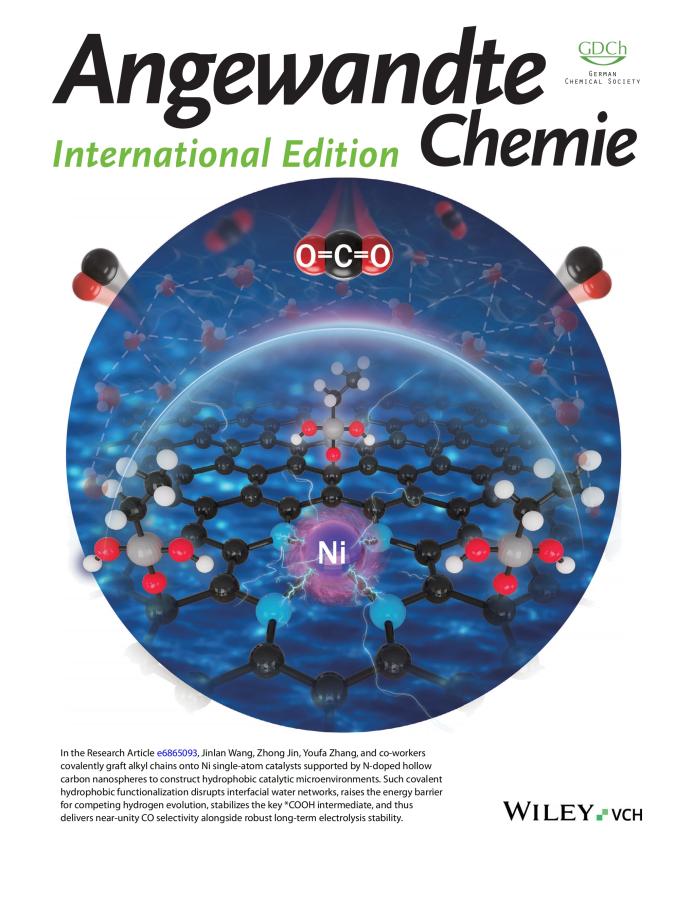
CO2RR is a key technology for promoting carbon resource recycling and utilizing electricity generated from clean energy sources. However, aqueous electrolyte systems suffer from two major limitations: the low solubility of CO2 in water and inefficient interfacial mass transfer; and the accumulation of abundant water molecules on catalyst surfaces, which triggers severe competing hydrogen evolution and substantially reduces CO selectivity. Current mainstream hydrophobic modification strategies mainly rely on physical coating or incorporation of hydrophobic components. During long-term electrolysis, these approaches often suffer from detachment of the hydrophobic layer, blockage of active sites, and increased interfacial resistance. Therefore, the stable construction of durable hydrophobic catalytic interfaces remains a critical challenge limiting the industrial application of CO2RR.
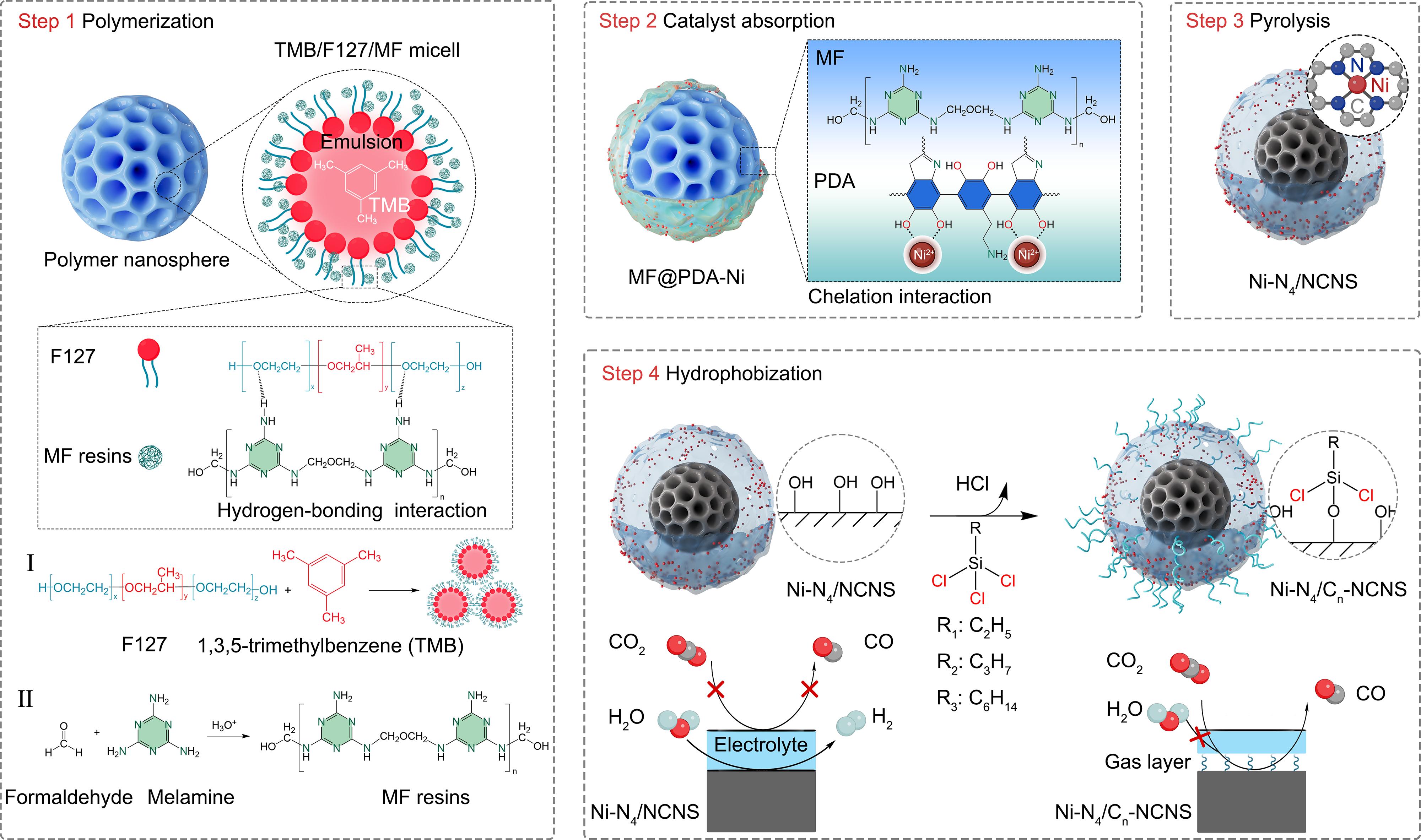
To address these bottlenecks, the collaborative team developed a covalent hydrophobization strategy. First, melamine–formaldehyde resin nanospheres were used as templates, followed by coating with polydopamine to coordinate Ni ions. After high-temperature pyrolysis, hollow nitrogen-doped carbon-supported Ni single-atom substrates were obtained. Subsequently, alkyl chlorosilanes were reacted with hydroxyl groups on the carbon support surface through a substitution reaction, anchoring alkyl chains firmly onto the catalyst surface via covalent bonds and yielding a series of hydrophobic single-atom catalysts. Compared with conventional physical modification, the covalently bonded structure provides significantly enhanced stability while fully preserving the Ni–N₄ single-atom active sites.
Electrochemical tests demonstrated that the C2 alkyl-modified Ni–N4/Cn-NCNS catalyst exhibited markedly enhanced catalytic performance. In an H-type electrolytic cell, the CO Faradaic efficiency reached 96.6% at −0.8 V, far exceeding that of the unmodified catalyst, which was 78.0%. At −1.0 V, the hydrogen evolution efficiency decreased from 38.3% to 2.3%, indicating substantial suppression of the competing side reaction. In a flow-cell system that more closely resembles industrial application conditions, the catalyst achieved a CO Faradaic efficiency as high as 99.6% at −0.6 V and maintained over 90% selectivity across a broad potential window. It also operated stably for 32 h at a high current density of 108.2 mA cm-2, demonstrating outstanding long-term catalytic durability.
In situ spectroscopy, DFT calculations, and molecular dynamics simulations confirmed that the hydrophobic alkyl chains disrupted the hydrogen-bond network of water molecules surrounding the active sites, increased the energy barrier for hydrogen evolution, enriched interfacial CO2, and stabilized the key *COOH intermediate. As a result, a stable “water-deficient, gas-enriched” three-phase reaction interface was established. This study demonstrates that catalytic selectivity is jointly governed by the intrinsic active sites and the local microenvironment. The covalent hydrophobization strategy provides a general design principle for various gas-involved electrocatalytic reactions and offers important theoretical guidance for the development of efficient catalysts for CO2 resource utilization.
The first author of the paper is Yanzheng Ji,a PhD candidate,from the School of Materials Science and Engineering, Southeast University. Prof. Youfa Zhang from Southeast University, Prof. Zhong Jin from Nanjing University, and Prof. Jinlan Wang from Southeast University are the co-corresponding authors. This work was supported by the National Natural Science Foundation of China, the National Key Research and Development Program of China, and other funding programs.
Paperlink:https://onlinelibrary.wiley.com/doi/abs/10.1002/anie.6865093

