

Prof. Guixiang Li Publishes Perspective Article on Temperature-Cycling Resilience of Perovskite Photovoltaics in Nature Reviews Materials
Recently, Prof. Guixiang Li and collaborators published a perspective article entitled “Resilience pathways for halide perovskite photovoltaics under temperature cycling” in Nature Reviews Materials. The article provides a comprehensive analysis of the impact of thermal cycling on the operational stability of perovskite photovoltaic devices and outlines strategies to enhance their resilience under fluctuating temperature conditions, offering important guidance for the future commercialization of perovskite solar technologies.
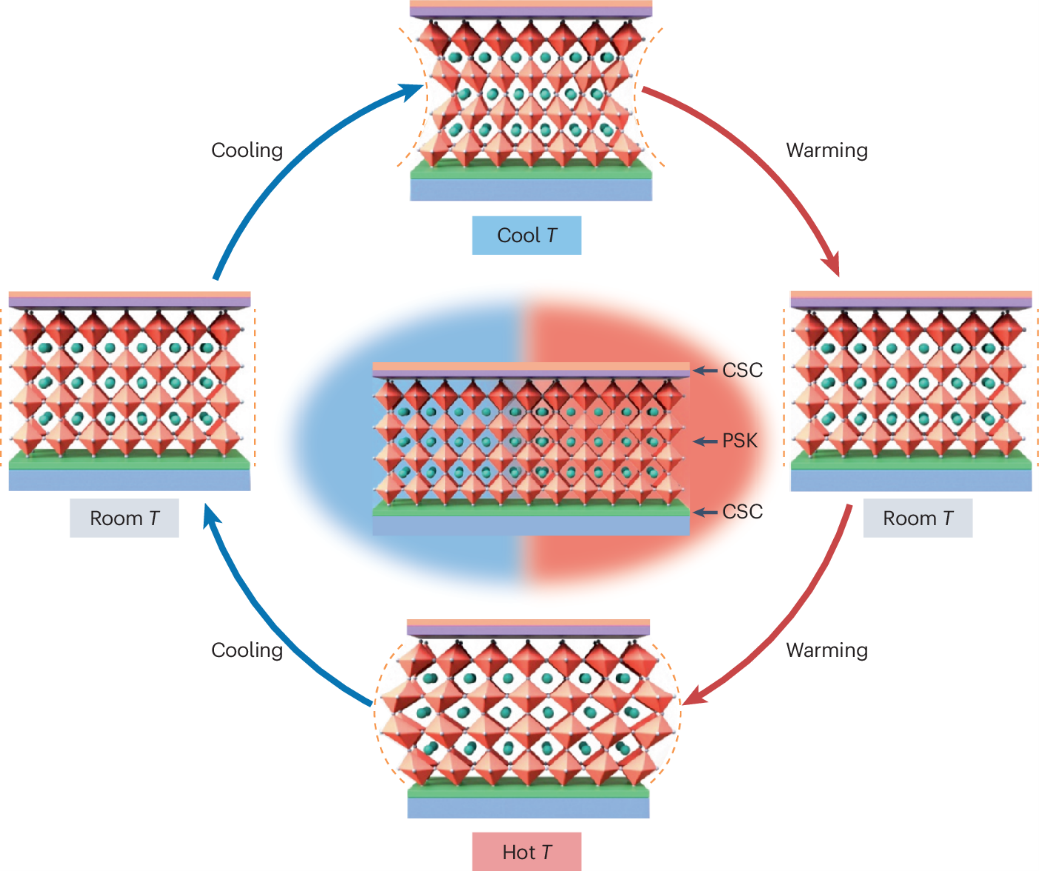
Metal halide perovskite solar cells are widely regarded as one of the most promising next-generation photovoltaic technologies owing to their high efficiency, low manufacturing cost, and compatibility with lightweight and flexible applications. However, long-term stability remains one of the major obstacles to large-scale deployment. In particular, temperature fluctuations encountered during outdoor operation can induce irreversible phase transitions, accelerate ion migration, and generate interfacial stress due to thermal expansion mismatch among device components, ultimately leading to performance degradation and reduced operational lifetime.
In this article, the authors systematically review the fundamental degradation mechanisms associated with temperature cycling in perovskite photovoltaics. The perspective highlights how repeated thermal stress influences material properties, interfaces, and device architectures, and discusses the critical challenges that must be addressed to ensure reliable operation under realistic environmental conditions.
To improve temperature-cycling resilience, the authors propose several promising strategies, including enhancing the intrinsic thermal stability of perovskite materials through compositional engineering and interfacial modification, introducing stress-buffering layers to mitigate mechanical degradation, and developing advanced encapsulation approaches to reduce the impact of environmental stressors such as temperature and humidity. The article also emphasizes the importance of establishing more rigorous and application-relevant temperature-cycling testing protocols that better reflect real-world operating conditions.
By integrating recent advances in materials design, interface engineering, device architecture, and reliability assessment, this work provides a comprehensive roadmap for developing durable perovskite photovoltaic technologies and accelerating their transition from laboratory research to commercial deployment.
The work was supported by the School of Materials Science and Engineering at Southeast University and international collaborators, further highlighting Southeast University’s growing impact in the fields of advanced energy materials and photovoltaic technologies.
The co-first authors of the article are Dr. Luyan Wu, Dr. Shuaifeng Hu, and Dr. Feng Yang. Corresponding authors include Prof. Guixiang Li (Southeast University), Prof. Antonio Abate (Helmholtz-Zentrum Berlin for Materials and Energy), Prof. Meng Li (Henan University), and Dr. Jorge Pascual (University of the Basque Country, Spain).
Article Link:
Nature Reviews Materials (2025)
https://doi.org/10.1038/s41578-025-00781-7

