

Prof. Guixiang Li’s Team Publishes Breakthrough Research on Perovskite Solar Cell Stability in Nature Photonics
Recently, Prof. Guixiang Li’s research team from the School of Materials Science and Engineering at Southeast University achieved a significant breakthrough in emerging photovoltaic technologies. The research, entitled “Stabilizing high-efficiency perovskite solar cells via strategic interfacial contact engineering”, was published in the prestigious journal Nature Photonics. The study addresses the long-standing stability bottleneck hindering the commercialization of perovskite solar cells and presents an innovative full-interface engineering strategy, providing a new pathway toward high-efficiency and durable hybrid semiconductor photovoltaic devices.
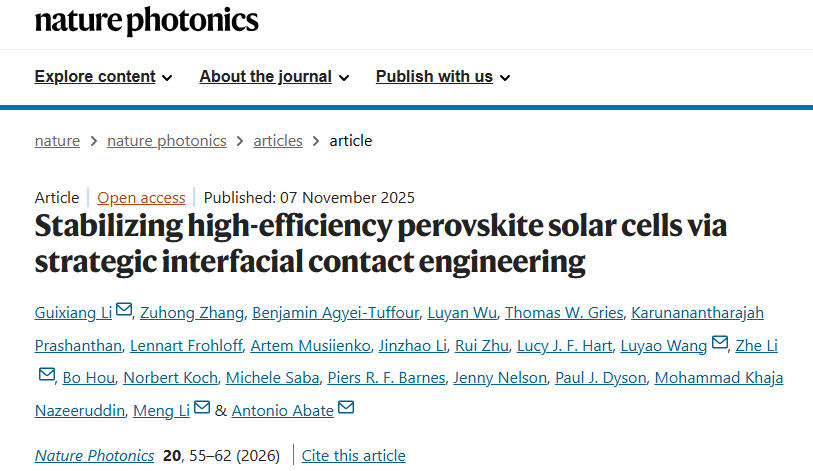
Metal halide perovskite solar cells have emerged as one of the most promising next-generation photovoltaic technologies owing to their excellent optoelectronic properties and compatibility with scalable manufacturing. However, insufficient thermodynamic and kinetic stability under multiple external stresses, including heat, moisture, and illumination, remains a major obstacle to commercialization. In particular, interfacial defects often accelerate performance degradation and limit long-term device operation.
To address this challenge, Prof. Li’s team has long focused on the interfacial physics and stability mechanisms of advanced photovoltaic devices. In this work, the researchers developed an integrated interface-engineering strategy that simultaneously regulates the photoactive layer surface, contact interfaces, and electron-transport layer. This design delivers three key advantages:
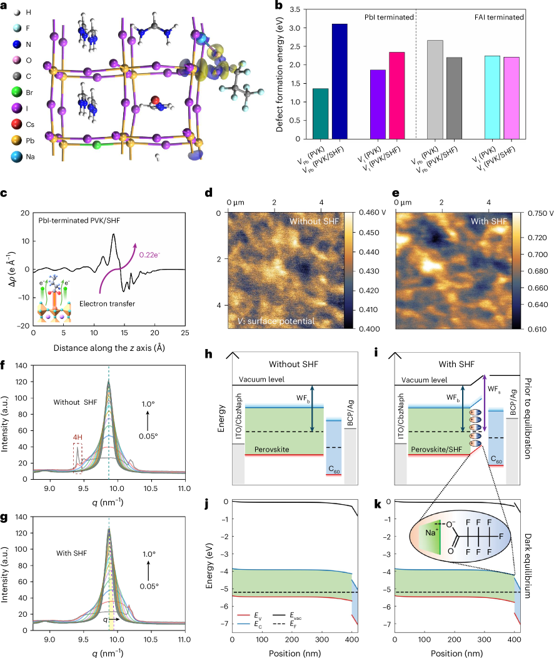
1. Significantly increases the defect formation energy at the perovskite surface, thereby fundamentally enhancing structural stability;
2. Introduces interfacial dipoles to optimize energy-level alignment, leading to more efficient charge extraction and transport;
3. Promotes the formation of dense and uniform electron-transport layers, effectively suppressing ion migration and electrode corrosion.
Through this comprehensive interfacial engineering approach, the team achieved perovskite solar cells with a power conversion efficiency of 27.0% and a certified efficiency of 26.96%. The devices also exhibited outstanding operational durability, showing almost no performance degradation after 1,200 hours of continuous illumination. Moreover, they maintained excellent structural integrity and photovoltaic performance during thermal aging at 85°C and under temperature cycling between –40°C and +85°C. These findings provide a practical and effective route toward overcoming the operational stability challenges of perovskite solar cells.
The School of Materials Science and Engineering at Southeast University served as the primary and corresponding institution for this work. The first authors of the paper are Prof. Guixiang Li, doctoral student Zuhong Zhang, Associate Prof. Benjamin Agyei-Tuffour, and Dr. Luyan Wu. Corresponding authors include Prof. Guixiang Li (Southeast University), Associate Prof. Luyao Wang (Xiamen University), Prof. Zhe Li (Queen Mary University of London), Prof. Meng Li (Henan University), and Prof. Antonio Abate (Helmholtz-Zentrum Berlin for Materials and Energy). The research was supported by the School of Materials Science and Engineering at Southeast University, related research platforms, and multiple funding agencies.
Article Link:
Nature Photonics
https://doi.org/10.1038/s41566-025-01791-1

