

Prof. Guixiang Li Publishes Research on Light-Cycling Stability of Perovskite Solar Cells in Nature Energy
Recently, Prof. Guixiang Li from the School of Materials Science and Engineering at Southeast University, together with collaborators from China and abroad, reported a significant advance in the field of outdoor operational stability of perovskite photovoltaics. The work, entitled “Photoswitchable isomers to improve grain boundary resilience and perovskite solar cells stability under light cycling”, was published in Nature Energy.
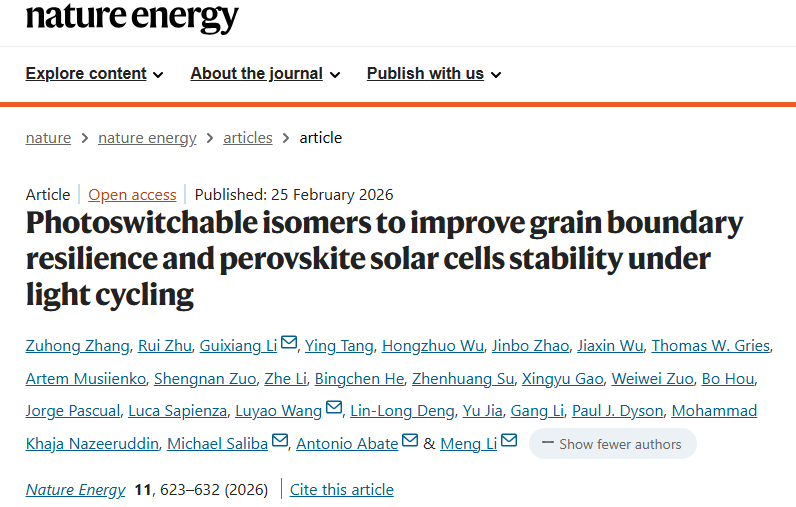
The study was jointly led by Prof. Guixiang Li (Southeast University), Prof. Meng Li (Henan University), Prof. Antonio Abate (Helmholtz-Zentrum Berlin for Materials and Energy, Germany), Prof. Michael Saliba (University of Stuttgart, Germany), and Associate Prof. Luyao Wang (Xiamen University). Southeast University served as one of the corresponding institutions.
Metal halide perovskite solar cells have achieved remarkable power conversion efficiencies in recent years. However, their long-term operational stability under realistic outdoor conditions remains a major challenge for commercialization. Under day–night light cycling and ultraviolet irradiation, repeated lattice expansion and contraction generate mechanical stress at grain boundaries, accelerating defect formation, phase instability, and device degradation. Addressing such dynamic stress-induced degradation has become a critical scientific challenge in the field.
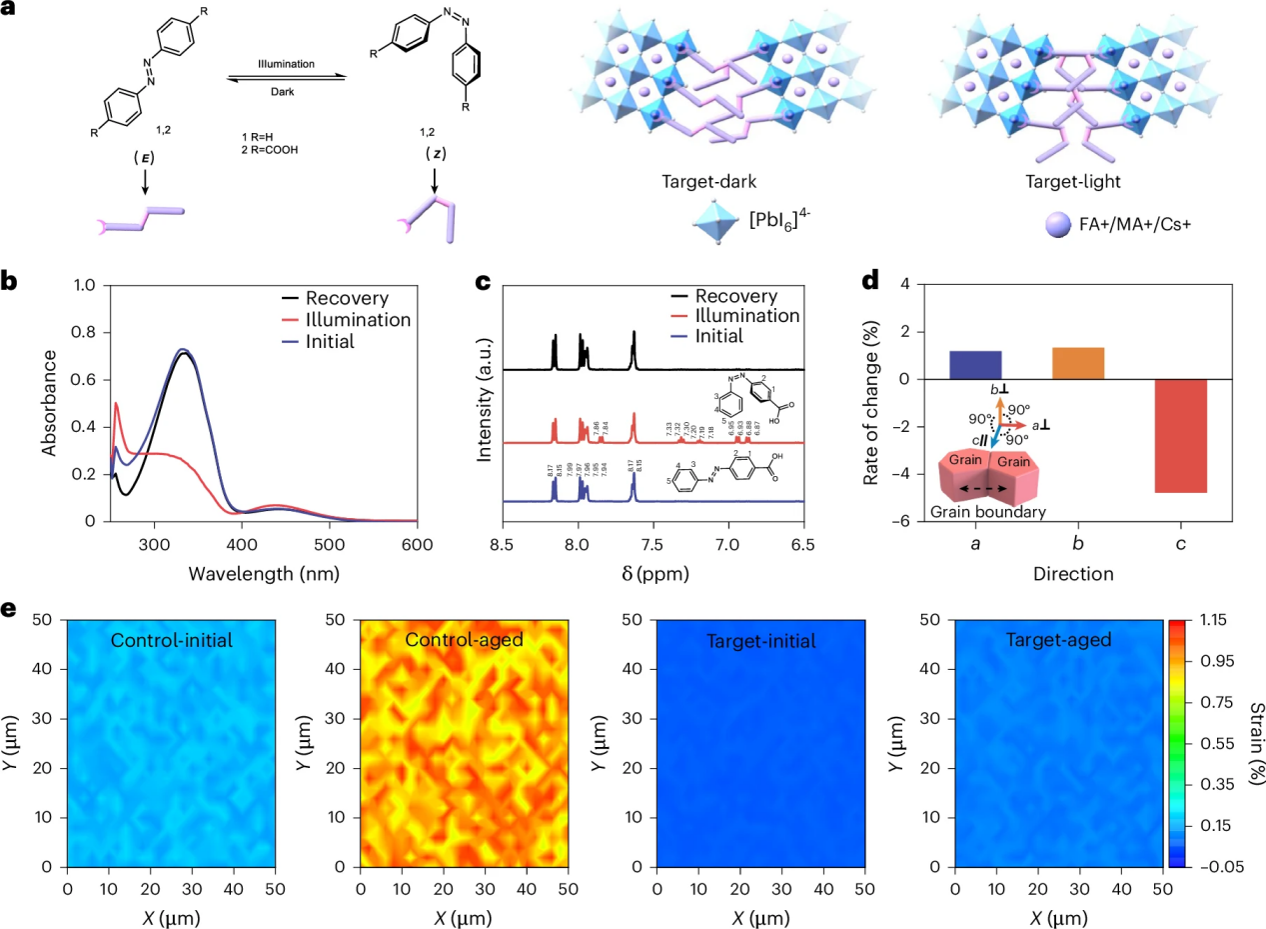
To tackle this issue, the research team developed a “photoresponsive molecular spring” strategy by introducing a photoswitchable azobenzene derivative (Ca-Abz) at perovskite grain boundaries. The molecule undergoes reversible structural transformations under alternating light and dark conditions, enabling dynamic absorption and release of strain energy. This process effectively dissipates mechanical stress generated during light cycling while simultaneously passivating defects through coordination interactions with Pb(II), thereby enhancing both structural resilience and interfacial quality.
Based on this strategy, the team achieved perovskite solar cells with a certified stabilized efficiency of 26.7% and a peak power conversion efficiency of 27.2%. The devices retained over 95% of their initial performance after 2,000 hours of simulated daylight cycling at 65°C under ultraviolet-containing illumination. Furthermore, they maintained 95.7% of their initial efficiency after 500 thermal cycles between −40°C and +85°C, demonstrating exceptional resistance to both light-induced and thermomechanical degradation.
This work provides a new materials-design paradigm for improving the operational durability of perovskite optoelectronic devices under complex environmental conditions and represents an important step toward the practical deployment of next-generation photovoltaic technologies.
The research was supported by the National Natural Science Foundation of China, the Jiangsu Provincial Basic Research Program, and related research platforms at Southeast University.
Article:
Photoswitchable isomers to improve grain boundary resilience and perovskite solar cells stability under light cycling
Nature Energy (2026)
https://www.nature.com/articles/s41560-026-01993-z
About Prof. Guixiang Li
Prof. Guixiang Li is a Professor in the School of Materials Science and Engineering at Southeast University. His research focuses on hybrid semiconductor materials and optoelectronic devices, with particular emphasis on defect engineering, interface design, and operational stability mechanisms. His work aims to advance the reliable operation and practical deployment of perovskite optoelectronic technologies. He has published extensively in leading journals, including Science, Nature Reviews Materials, Nature Photonics, Nature Energy, Nature Communications, and Advanced Materials.

