

Professor Xinli Guo’s group published research progress on lithium battery in Journal of the American Chemical Society
Recently, Prof. Xinli Guo’s group at our school, in collaboration with Academician Zhongwei Chen, Researcher Dan Luo, and Researcher Dongdong Wang from the Dalian Institute of Chemical Physics, Chinese Academy of Sciences, proposed a “polarity-contrast” electrolyte design strategy. This approach successfully constructs a stable anion-dominated solvation structure at low temperatures by regulating ion–dipole interactions between anions and solvent molecules. The related work, entitled “Anion Coordination Transition Enabled by Ion-Dipole Interactions At Low Temperatures,” was published in Journal of the American Chemical Society, with Southeast University listed as the first affiliated institution.
Lithium metal batteries have attracted extensive attention for applications in electric vehicles and grid-scale energy storage, but suffer from poor performance at low-temperature that severely limits their practical deployment. Under low-temperature conditions, sluggish ionic transport in the electrolyte bulk, slow desolvation kinetics at the electrode/electrolyte interface, and hindered solid-state diffusion collectively result in severe capacity decay and aggravated polarization. Conventional electrolyte engineering strategies primarily rely on regulating Li⁺–solvent interactions to construct anion-involved solvation structures, such as by employing weakly solvating solvents or localized high-concentration electrolytes. However, these strategies encounter fundamental limitations at low temperatures: as the thermal motion of solvent molecules decreases, strengthened Li⁺ coordination expels anions from the solvation sheath, leading to sharply reduced ion-transport efficiency and dramatically increased interfacial charge-transfer resistance. Therefore, the development of new electrolyte design paradigms capable of sustaining anion-dominated solvation structures under low-temperature conditions is urgently needed.
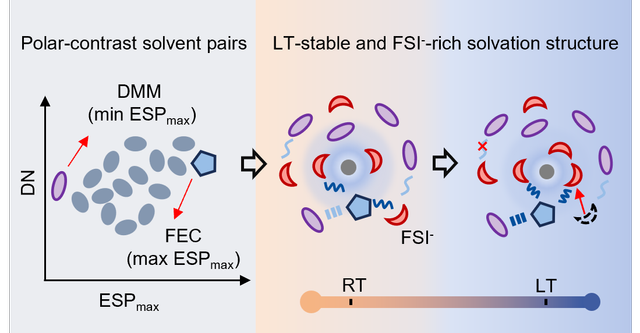
In this work, the research team systematically regulated the interactions between solvents and the FSI⁻ anion, proposing a “polarity-contrast” strategy by selecting a solvent pair with the lowest and highest maximum electrostatic potential (ESPmax): dimethoxymethane (DMM) and fluoroethylene carbonate (FEC), respectively. By precisely tuning ion–dipole and dipole–dipole interactions, the weakened interaction between the primary solvent (DMM) and FSI⁻ at low temperatures facilitates anion-involved solvation coordination. Meanwhile, the coordinated FEC co-solvent strengthens ion–dipole interactions with FSI⁻, thereby further anchoring the anions within the solvation sheath. This FSI⁻-dominated solvation environment promotes the formation of a fluorine-rich solid electrolyte interphase (SEI), enabling uniform lithium deposition under low-temperature conditions. As a result, Li||SPAN full cells exhibited outstanding low-temperature electrochemical performance, including a high areal capacity of 4.5 mAh cm⁻² at −40 °C and 80% capacity retention after 150 cycles. Notably, Ah-level Li||SPAN pouch cells achieved stable operation for 50 cycles at −20 °C, demonstrating an exceptional balance among capacity, temperature tolerance, and cycling lifespan that surpasses most previously reported low-temperature lithium metal batteries.
The first author of the paper is Jingxuan Ren, a doctoral student from the School of Materials Science and Engineering at Southeast University. The corresponding authors are Prof. Xinli Guo from Southeast University, and Academician Zhongwei Chen, Research Scientist Dan Luo, and Research Scientist Dongdong Wang from the Dalian Institute of Chemical Physics, Chinese Academy of Sciences.
Paper link:https://doi.org/10.1021/jacs.6c03001

